Hawaii Sea Turtle Rules: How Close Can You Legally Get?
The Hawaii sea turtle rules are simpler than the internet makes them sound, and one number does most of the confusing. NOAA Fisheries asks everyone to stay at least 10 feet, or 3 metres, from a honu, on land and in the water. That number gets repeated everywhere, but it is a recommended viewing distance, not the actual law. The law that governs how close is too close is the federal Endangered Species Act's ban on harassing a protected animal, and that standard is about behavior, not a tape measure. We wrote this after fielding the same question from riders on almost every trip out to Turtle Canyon: what happens if a turtle swims right up to me. Here is the honest answer, the actual regulations behind it, and what a responsible Oahu operator does differently.
Quick answer
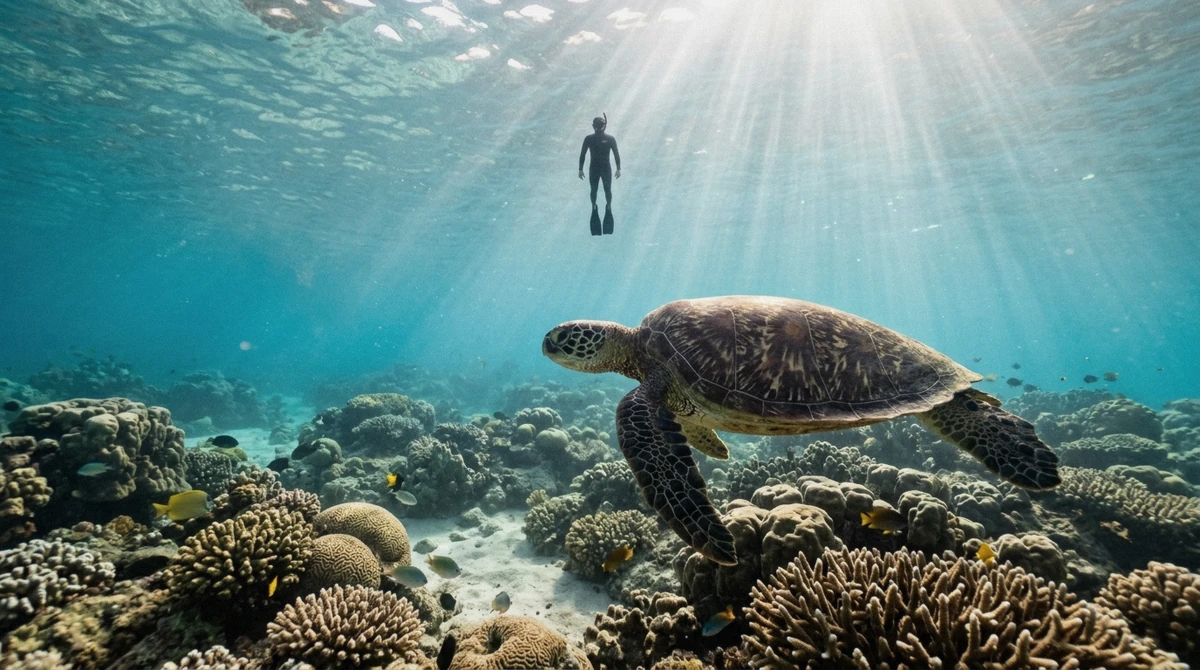
NOAA Fisheries recommends staying at least 10 feet, or 3 metres, from a sea turtle on land or in the water, but that figure is a guideline, not the legal line itself. The real legal standard is the federal Endangered Species Act's prohibition on harassment, so a turtle that glides to within a foot of a motionless snorkeler breaks no law, while a swimmer who chases or corners one from 15 feet away can.
Key takeaways
- The legal floor is the Endangered Species Act's harassment standard, not a fixed number of feet
- Hawaii adds its own layer of protection through HRS Chapter 195D and Hawaii Administrative Rules 13-124
- Maximum statutory penalties reach $25,000 federally and $50,000 under Hawaii law, though documented enforcement has settled far lower
- Our small-group Turtle Canyon boat briefs every rider on these distances before anyone gets in the water
- Bringing children on the trip? see how we cover the same rules in plain language for turtle snorkeling with kids
- Want to watch honu without booking a boat at all? these shore-based spots run under the same distance rules
How Close You Can Legally Get, and Why 10 Feet Is a Guideline, Not a Line
NOAA Fisheries publishes 10 feet, or 3 metres, as the recommended distance to keep from a Hawaiian green sea turtle, whether it is resting on the sand or grazing on a reef. That number applies on land and in the water, and it is the figure every operator on this site repeats in the pre-snorkel briefing. It is a good, simple rule to carry into the water with you.
What the 10-foot figure is not, though, is a hard legal boundary measured with a tape. Honu are protected under the federal Endangered Species Act, and the ESA prohibits harassment, defined as any act that disturbs or is likely to disturb an animal's normal behavior, including its feeding, resting, or migrating. That standard is about what you do, not exactly how many feet separate you from the turtle.
A honu that swims up and settles beside a snorkeler who is floating still, breathing quietly, and not reaching out has not been harassed by that snorkeler, even though the gap is well under 10 feet. A person who is 15 feet away but actively swimming after a turtle, cutting off its path back to open water, or free-diving down to hover directly over a basking animal is disturbing its normal activity, and that is the behavior the law actually targets.
Hawaii layers its own protection on top of the federal rule, through HRS Chapter 195D and Hawaii Administrative Rules 13-124, which classify honu as protected wildlife under state law as well. Sea turtles are covered by the Endangered Species Act, not the Marine Mammal Protection Act, which is a common point of confusion since the MMPA governs a different set of Hawaii animals entirely, the monk seals, spinner dolphins, and humpback whales you might also see on the water. We cover exactly how those animals differ, and why their distances are stricter, further down this page.
Boats That Brief the Rules Before You Get In
Every operator listed here runs a pre-snorkel briefing that covers these exact distances, and crew stay in the water with the group to enforce them. Here are three that do it particularly well.
 from $85
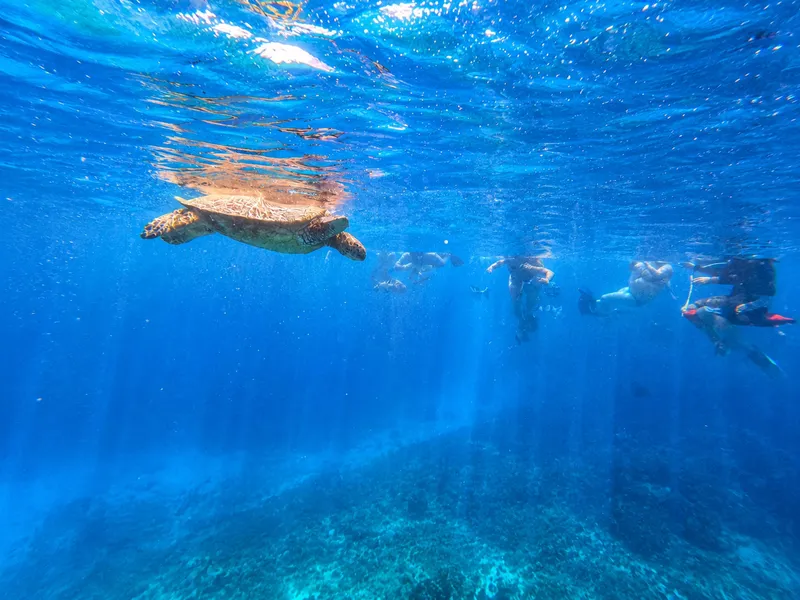
 Waikiki Turtle Canyon Snorkeling Tour — Small Group (6 People Max)
Snorkel Turtle Canyon off Waikiki with the operator advertising guaranteed sea turtle sightings. Choose an intimate 6-person catamaran or a small-group 18-person shared boat, with expert guides and…
- Operator advertises guaranteed sightings at Turtle Canyon
- Intimate 6-person catamaran or 18-person shared boat
- Expert guides and premium snorkel gear included
- Departs minutes from Waikiki Beach
 from $194
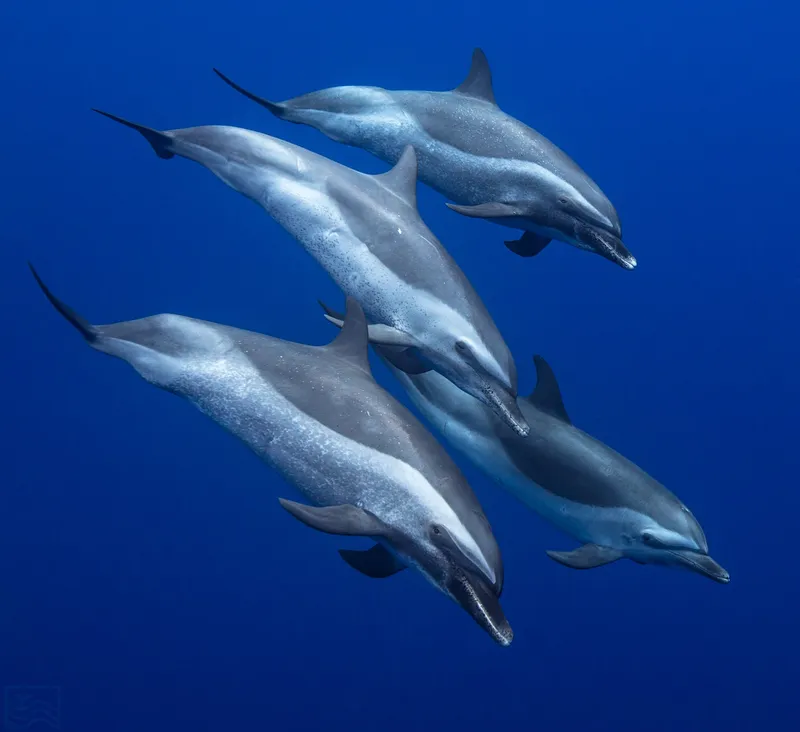
 Dolphin Swim & Turtle Snorkel Excursion from Waianae, Oahu
Search for wild dolphins and whales on a snorkel excursion led by marine biologists and naturalists, with dolphin sightings guaranteed. Swim with turtles and tropical fish from a…
- Guided by marine biologists and naturalists
- Wild dolphin sightings guaranteed
- Swim with turtles and tropical reef fish
- USCG-inspected vessel from the Waianae coast
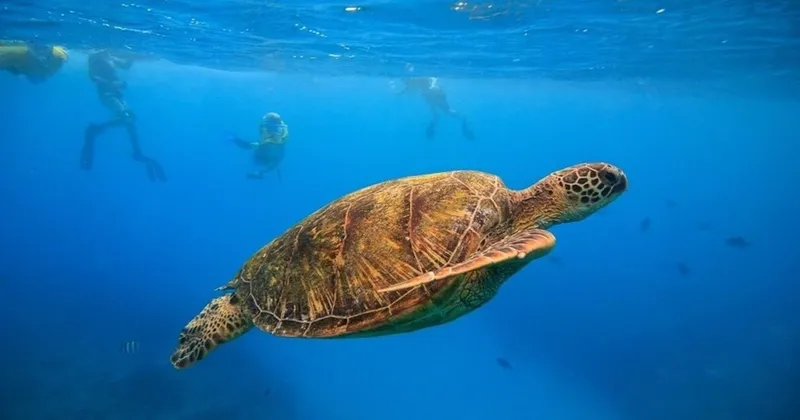 from $89
 Waikiki Turtle Canyons Cruise & Snorkel Excursion, Oahu
Take a city cruise for the rare chance to snorkel with endangered Hawaiian green sea turtles and fish at the Turtle Canyons off Waikiki. Enjoy light snacks and…
- Snorkel with endangered Hawaiian green sea turtles
- Turtle Canyons reef off the Waikiki coast
- Light snacks and drinks included
- Relaxed city cruise out and back
The Rules in One Table: Animal, Distance, Guideline or Law
Not every animal you might see off Oahu carries the same rule, and the difference between a recommendation and a federal law matters. Here is the full set, as published by NOAA Fisheries for marine wildlife viewing in Hawaii.
| Animal | Distance | Status |
|---|---|---|
| Sea turtles (honu) | At least 10 feet (3 metres), on land and in water | Recommended guideline |
| Hawaiian monk seals | At least 50 feet (about 15 metres); 150 feet from a mother with a pup | Recommended guideline |
| Spinner dolphins | 50 yards; no swimming with or approaching | Federal law |
| Humpback whales | 100 yards, by boat, kayak, drone, or swimmer | Federal law |
Turtles and monk seals sit under a recommended viewing distance, backed by the harassment standard described above. Spinner dolphins and humpback whales sit under an explicit federal regulation with a specific yardage written into it, no interpretation required. That is the practical difference: with a turtle, the question is always whether your behavior disturbed it; with a dolphin or whale, simply closing the stated distance is itself the violation, regardless of your behavior.
What Counts as Harassment Under the Endangered Species Act
The Endangered Species Act's language is broad on purpose, and it covers more than the obvious cases. Harassment includes any act that creates the likelihood of injury or disrupts normal behavior patterns, which in practice covers chasing a turtle to get a closer photo, cornering one against a reef wall or the shoreline, blocking its route back to open water, repeatedly diving down to hover directly above a resting animal, and using flash photography close to a basking turtle at night or in low light.
It also covers slower, less obvious pressure: a group of snorkelers surrounding a single turtle so it has no clear direction to swim away, or a swimmer following a turtle persistently even at a wide distance, so the animal changes its feeding or resting pattern to get away from the attention. The standard is the turtle's behavior, not yours. If a honu changes course, speeds up, dives to avoid you, or abandons a cleaning station because of your presence, harassment has likely occurred, even if you never got within 10 feet.
Penalties, and What Enforcement Actually Looks Like
The maximum statutory penalties are steep by design. Civil penalties under the Endangered Species Act are widely cited at up to $25,000 per violation, and Hawaii's own state protection under HRS 195D carries penalties up to $50,000. Those are ceilings written into the law to give enforcement real teeth, not the amount most people should expect to pay if something goes wrong.
Real enforcement tends to land far below the maximum. The clearest documented case involves a visitor from Alabama who touched a Hawaiian monk seal and harassed a sea turtle on Kauai, in violations that occurred in the autumn of 2017; NOAA Fisheries reported the case settled for a $1,500 summary settlement, announced in August 2018. That is the one figure we can point to with a source behind it, and we are not going to guess at others.
The gap between a $25,000 ceiling and a $1,500 real-world settlement should tell you enforcement is serious but proportionate, not that the rules are toothless.
Never Do These: The Short List
A handful of actions are never acceptable around a honu, in any circumstance, regardless of how close the turtle chooses to come to you.
- Touching, patting, or petting a turtle
- Riding on a turtle's shell
- Holding, lifting, or restraining a turtle
- Chasing or actively swimming after one to get closer
- Feeding a turtle anything, ever
- Standing or swimming between a basking turtle and the water
- Blocking a turtle's path back to open water
- Cornering a turtle against a reef, rock, or the shoreline
How to Behave When a Honu Swims Toward You
This is the moment nearly every rider on our boats asks about beforehand, and it happens on most trips: a turtle surfaces or glides in close on its own. The right response is almost entirely about doing less, not more.
- Stop kicking and go still in the water
- Keep your arms at your sides, don't reach out
- Let the turtle set the distance; it will move away if it wants space
- Angle your fins away from its shell and flippers
- Skip the flash if you're shooting a photo
- Move parallel to its path if you need to reposition, never head-on
- Exit the area calmly rather than backing away in a rush
Reef-Safe Sunscreen and What Hawaii Law Actually Bans
Hawaii Act 104, signed in 2018, made it illegal to sell, offer for sale, or distribute sunscreen containing oxybenzone or octinoxate anywhere in the state without a prescription, and that ban has been in effect statewide since 1 January 2021. It is a sales law aimed at retailers and distributors, not a rule that fines a visitor for wearing sunscreen they packed from home.
Maui County goes further with its own Ordinance 5306, in effect since 1 October 2022, which bans the sale, use, and distribution of non-mineral sunscreen without a prescription within Maui County specifically. Maui County does not include Oahu. If you are snorkeling off Waikiki or Waianae, you are under the statewide Act 104 sales ban only, and there is no separate use ban that applies to you here.
The simplest way to stay well inside both laws and be reef-conscious either way is to pack a mineral sunscreen, zinc oxide or titanium dioxide as the active ingredient, or cover exposed skin with a rash guard, which is what most of our crews recommend on the boat regardless of which island you're on.
Spinner Dolphins and Humpbacks Are Different Animals Under Different Laws
Honu are sea turtles, protected under the Endangered Species Act rather than the Marine Mammal Protection Act, which is the law that governs Hawaii's actual marine mammals: monk seals, spinner dolphins, and humpback whales. It is a common mix-up because all four animals show up on the same stretch of coast, but the legal frameworks, and the consequences of getting close, are not interchangeable.
Spinner dolphins are protected by a specific federal rule that prohibits swimming with, approaching, or remaining within 50 yards of them, full stop, no behavior test involved the way there is with turtles. That is why we never describe our Waianae dolphin-and-turtle trip as swimming with spinner dolphins. What it actually offers is watching wild dolphins from the boat at a lawful distance, then snorkeling over the reef separately, where turtles and tropical fish are the animals you get in the water with.
Humpback whales carry their own 100-yard federal buffer, which matters most from December through April, when whales are commonly seen from south-shore boats heading out to Turtle Canyon.
How to Tell a Responsible Operator From a Careless One
The single biggest factor in whether your own trip stays inside these rules is which boat you book, since crew behavior sets the tone for everyone in the water. A responsible operator runs a real briefing before anyone gets wet, names the 10-foot guideline specifically, and has a crew member in the water watching group behavior, not just watching for turtles to point out. A careless one skips the briefing, drives the boat close to a resting or basking turtle for a better photo angle, or lets guests chase an animal that is clearly trying to move away.
Here is what that looks like across three of the boats we recommend, priced and timed so you can compare what you're actually getting for the money.
| Tour | Duration | Price | What's included |
|---|---|---|---|
| Waikiki Turtle Canyon Snorkeling Tour, small group | 2 hours | $85 | Mask, snorkel, fins, flotation, crew-enforced distance rules, 6-person catamaran option |
| Dolphin Swim & Turtle Snorkel Excursion from Waianae | 3 hours | $194 | Mask, snorkel, fins, flotation, marine biologist and naturalist guides, USCG-inspected vessel |
| Waikiki Turtle Canyons Cruise & Snorkel Excursion | 2 hours | $89 | Mask, snorkel, fins, flotation, light snacks and drinks, briefing on distance rules before entry |
Our small-group boat keeps the group tight enough that the crew can actually watch everyone's positioning around a turtle, which matters more than it sounds like it should once you're in open water and distances get hard to judge. The Waianae excursion runs with marine biologists and naturalists aboard, which is the clearest sign of an operator built around the animals rather than just the photo op. The Turtle Canyons cruise is the most-reviewed boat on this site, and its briefing covers the same 10-foot standard before anyone is allowed to jump in.
Reporting Harassment, and What Not to Do
If you see someone touching, chasing, or cornering a turtle, dolphin, or seal, the right move is to report it, not to confront the person directly in the water or on the beach. NOAA Fisheries asks the public to call the NOAA Marine Wildlife Hotline, 1-888-256-9840, to report suspected harassment of marine wildlife in Hawaii. Note what you saw, where, and roughly when, and let trained responders take it from there.
For the full text of the federal viewing guidelines, NOAA Fisheries publishes them at their marine wildlife viewing page, and the Hawaii DLNR's sea turtle page covers the state-level protections in more depth.
None of this is meant to make a first-time snorkeler nervous about getting in the water. Honu are genuinely comfortable around people who hold still and keep their hands to themselves, and plenty of encounters off Waikiki involve a turtle that swims closer than the 10-foot guideline entirely on its own terms. The rules exist to stop the small number of people who chase, touch, or corner a wild animal for a better photo.
Book with a crew that runs the briefing, keep your hands in, and the honu will do the rest. We compare operators that brief the honu rules properly so you can see which boats put that briefing first, and if you would rather start from the sand than from a boat deck, our guide to seeing turtles without a tour covers the shore spots, while what a turtle morning costs sets out the numbers.
Which Rules Matter Most for Your Trip
If you are snorkeling from a boat at Turtle Canyon
listen to the briefing, keep your fins still when a honu approaches, and let the crew set the group's position
If you are watching turtles on the sand at Laniakea
stay behind the ropes and cones, keep 10 feet or more, and never stand between a turtle and the water
If you are on a west-coast trip that looks for wild dolphins
remember the 50-yard spinner dolphin rule is federal law, so the watching happens from the deck
If you are visiting between December and April
expect boats to hold 100 yards off humpback whales, which is also federal law, not crew caution
If you are packing sunscreen at home
choose a mineral formula so you are covered under Hawaii's rules wherever you swim
Frequently Asked Questions
How close can you legally get to a sea turtle in Hawaii?
NOAA Fisheries recommends 10 feet, or 3 metres, as the guideline. The actual legal line is the Endangered Species Act's ban on harassment, which is a behavior standard, so a turtle that approaches a still snorkeler doesn't create a violation, while chasing or cornering one does, regardless of the exact gap in feet.
What happens if you touch a sea turtle in Hawaii?
Touching a honu can be treated as harassment under the Endangered Species Act and Hawaii's HRS 195D. Maximum statutory penalties reach up to $25,000 federally and up to $50,000 under state law, though the one documented case we found, a $1,500 summary settlement for touching a monk seal and harassing a turtle on Kauai, landed far below either ceiling.
Why can you swim near turtles but not near spinner dolphins?
Turtles fall under a recommended 10-foot viewing distance backed by a behavior-based harassment law. Spinner dolphins fall under an explicit federal rule that bans swimming with or approaching within 50 yards, with no behavior test involved, which is why boats describe watching dolphins rather than swimming with them.
What should you do if a turtle surfaces right next to you?
Stop kicking, keep your arms at your sides, and let the turtle decide the distance. Don't reach out, don't chase if it moves off, and skip the flash photography. Most close encounters happen because the turtle chose to approach, not the other way around.
Which sunscreen is legal to use in Hawaii?
Statewide, Act 104 bans the sale of sunscreen containing oxybenzone or octinoxate since 1 January 2021, but that's a sales law, not a use ban on visitors. On Oahu, a mineral sunscreen with zinc oxide or titanium dioxide, or simply a rash guard, keeps you comfortably inside every applicable rule.
Who do you call if you see someone harassing a turtle?
Call the NOAA Marine Wildlife Hotline at 1-888-256-9840 and report what you saw. Don't confront the person directly; trained responders handle it from there.